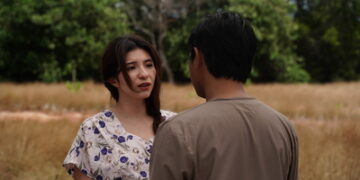



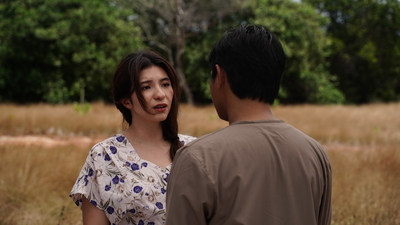
The Bell: Call for Death (original title: The Bell: Panggilan untuk Mati)
Now arrives as a striking example of how local folklore can be transformed into a cinematic experience that feels both intimate and expansive.
Indonesian horror continues to evolve
Following a series of special screenings across cities such as Jakarta, Bandung, Bogor, Tangerang, Depok, and Belitung
The latter being the folkloric origin of the story, the film officially opens nationwide today.
Early reactions highlight not only its chilling atmosphere, but also a lingering sense of curiosity that stays with audiences long after the credits roll.
At the heart of the film lies Penebok, a newly introduced horror icon derived from local myth. Unlike conventional horror figures,
Penebok is not merely a tool for fear, but a narrative vessel,bridging superstition, cultural memory, and modern anxieties.
This alone positions the film as more than just another entry in Indonesia’s thriving horror wave.
Trailer is here
Director Jay Sukmo takes a distinct visual approach, utilizing three different aspect ratios to represent shifts in time.
His intention is clear: to build terror through atmosphere and storytelling rather than relying solely on jump scares.
As he notes, the film aims to “frighten through situation and narrative,” an ambition that places it closer to psychological horror than purely visceral thrills.
Veteran actor Mathias Muchus echoes this sentiment, emphasizing the film’s cultural depth.
According to him, The Bell does not just present horror it introduces Penebok as part of a living mythos, giving the terror a sense of meaning that resonates beyond the screen.
Synopsis
The narrative itself is deceptively simple yet thematically layered.
A sacred bell in Belitung, believed to imprison malevolent spirits, is stolen by a group of YouTubers seeking viral content
.Their reckless pursuit of online fame unleashes Penebok, a terrifying headless entity in red, who begins to hunt them down one by one. As the horror spreads to the surrounding village, each toll of the bell becomes an omen of death.
What makes the film particularly relevant is its commentary on digital-era obsession.
The characters’ fatal mistake,trading respect for myth in exchange for virality,mirrors a real-world tension where cultural heritage is often commodified for content
. In this sense, The Bell functions as both a horror film and a cautionary tale.
A Glimpse of a “Rupawan” Cinematic Universe?
Beyond its immediate narrative, The Bell: Call for Death opens an intriguing possibility: the emergence of a new, aesthetically rich cinematic universe grounded in Indonesian culture.
Indonesia is home to thousands of myths, spirits, and regional legends, many of which remain unexplored in global cinema.
If Penebok is any indication, these stories have the potential to form an interconnected universe akin to modern franchise storytelling, but with a distinctly Indonesian identity.
Instead of relying on Western archetypes, such a universe could draw from local cosmologies, spiritual beliefs, and oral traditions, offering something visually unique and culturally authentic.
Imagine a series of films where each region introduces its own entity, each with its own rules, moral framework, and visual language, yet subtly connected through shared lore or ancient artifacts like the bell.
The use of varied cinematic techniques, like Sukmo’s aspect ratio experimentation, could further enhance this universe, giving each story a unique aesthetic signature while maintaining thematic cohesion.
With The Bell heading to the Cannes Film Market (May 12–20, 2026), the opportunity for international recognition is already within reach.
The Bell: Call for Death stands at an intersection: it is a horror film, a cultural statement, and potentially the first step toward something much larger.
Its blend of folklore, social commentary, and stylistic ambition suggests that Indonesian cinema is not just participating in global trends, it is ready to reshape them.
If this film succeeds in capturing both domestic and international audiences, it may very well mark the beginning of a new wave—one where the echoes of ancient myths ring louder than ever before.
Now playing in theaters across Indonesia.
Dare to listen when the bell rings.